Dragon Docks Deliver
sssssssss
In 2002, the telescope got a name. NASA administrator Sean O’Keefe broke a tradition of naming telescopes for scientists — the Hubble telescope, for instance, refers to the American astronomer Edwin Hubble — and instead honored an earlier administrator, James Webb, who was head of the space agency during the Apollo era. The choice was immediately unpopular with astronomers and has grown increasingly so. Last year, 1,200 astronomers signed a petition to rename the telescope after claims that Webb either aided or chose to ignore the firing of gay government employees during the Lavender Scare. After an investigation, NASA announced in October that historians found no evidence warranting a name change.
Various institutions, from the University of Arizona to the European Space Agency, signed up to build the cameras, spectrographs and coronagraphs that will swivel into place at the focal point of the optics, slicing and dicing different chunks of the pooled infrared light. In exchange, these institutional partners will command extensive telescope time.
As for the sunshield, the flimsy material on which the infrared telescope’s fate rests, the team quickly settled on Kapton, a slithery silver plastic that looks like the inside of a potato chip bag but has the thickness of a human hair. Since it might tear, the sunshield would need many layers for redundancy — the team decided on five — and the layers would have to be unfurled, separated and held taut by a system of booms, cables and strings. Propulsion systems and solar panels would go on the sunward side, and the optics and instruments, which must operate below minus 223 degrees Celsius, would huddle on the dark side. “JWST has a lot of firsts, an awful lot of significant firsts,” Menzel, the chief engineer, told me, “but that sunshield is one of them.”
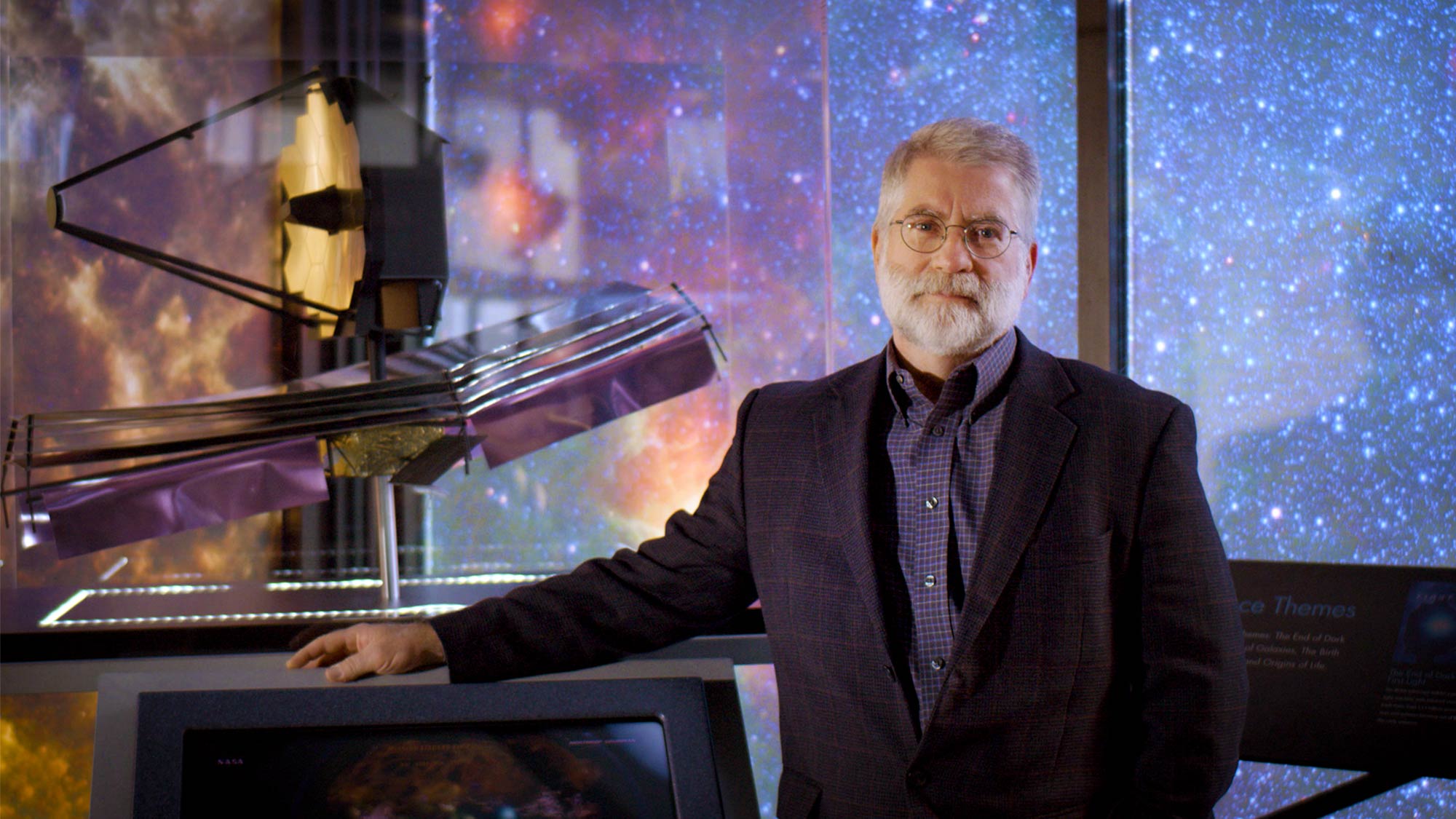
Menzel, who is thickset with a neatly clipped gray beard, oversees thousands of people’s work on one of the most complicated engineering projects in history; he’s also the type of person who tells you right away where they’re from. That would be Elizabeth, New Jersey — Exit 13 off the turnpike — where his father drove a cab. On a recent Zoom call, Menzel bent his arm back and forth at the elbow to explain the challenge presented by the sunshield. “If you take something rigid, like a door, and you build a nice hinge, you can predict the way that moves,” he said. “That’s a piece of cake.” He stopped bending his arm. “Now you got blankets. They’re floppy. Try to push on a blanket on your bed and predict the shape that it’s going to go in. It’s horrible. Same thing with a string — the strings that tension [the sunshield]. There’s a million different ways that a string can move.” It gets worse: “Now put all this experience in zero-G, where that stuff can go in places you just don’t want it to go.” Smoothly unfolding the sunshield “becomes a very tough problem.”
Around 2004, the NASA engineers Chuck Perrygo and Keith Parrish came into Menzel’s office at Goddard and said they had a way to do it. Perrygo picked up a piece of paper on Menzel’s desk and folded it into the shape of a Z. The sunshield could be folded into many more such zigzags, in what’s sometimes called an accordion fold. “I’m pretty good at recognizing a bad answer, and I’m pretty good at recognizing a right answer,” Menzel told me, holding up a piece of paper he had folded into a Z shape. “So we all saw that and thought, that’s a way to pursue it.” Northrop Grumman was separately coming to the same conclusion.
The next question was how to hold the accordion fold in place until the sunshield was ready to unfurl. A Northrop Grumman engineer, Andy Tao, found the solution: 107 pins that retract like a cat’s claws.
The pin approach sprouted another tricky problem: pins make pinholes. If, after unfurling, pinholes on all five Kapton layers were to line up, this would let a sunbeam through, heating the optics. “It was one of those arcane little details that you’d never guess until you start getting into it and you start finding out, ah, Christ, five of the pinholes are lining right up and that’s going to let sunlight right in,” Menzel said. “It doesn’t sound like much, but it was driving Andy to drink. And God bless him, he figured it out.” Tao diligently sought out a suitable configuration of pins so that the holes in the five slightly-different-size Kapton layers would never align from any angle.



3 Comments
bandur-art.Blogspot.com
These aare truly wonderful ideas inn regarding blogging. Yoou have touched some nice things here. Any way keep up wrinting. https://Bandur-Art.Blogspot.com/2024/08/the-ultimate-guide-to-no-mans-sky-mods.html
Christoper Dickinson
Hello laraconseil.ma admin, Your posts are always thought-provoking and inspiring.
NikeSit
dark web sites links dark web drug marketplace tor dark web